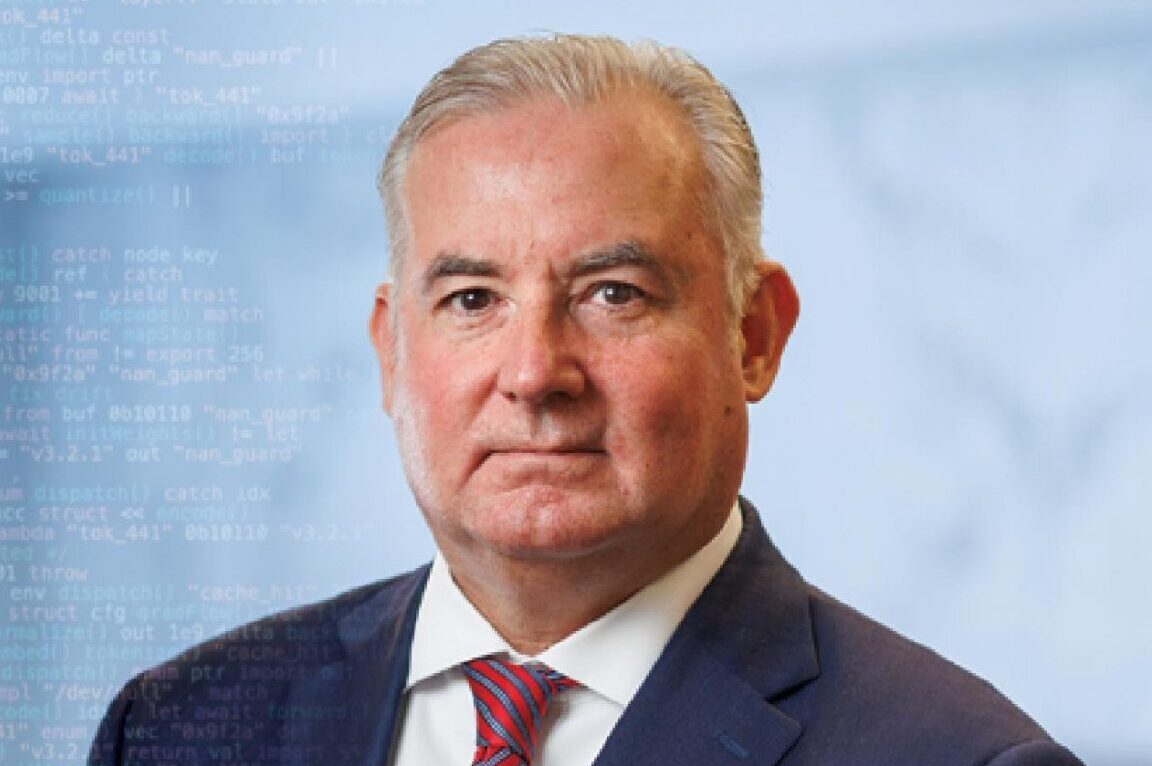
John Harris, Managing Director and Chief Wealth Advisor of Coral Gables Trust.
BY YOUSRA BENKIRANE
“ I’M PRO AI, I’M PRO TECHNOLOGY, BUT I’M ALSO PRO HUMAN JUDGMENT… ”
JOHN HARRIS MANAGING DIRECTOR AND CHIEF WEALTH ADVISOR OF CORAL GABLES TRUST
For years, technology changed wealth management incrementally: better trading platforms, cleaner dashboards, faster reporting. Artificial intelligence is different. A financial advisor can now ask an internal AI system to search thousands of pages of proprietary research in seconds. A trust company can run an initial analysis of hundreds of pages of estate documents. Software can summarize a client meeting, identify action items and draft the follow-up email before the advisor has returned to his desk. Clients have access to their own version of the same revolution. They can ask AI to research an investment, explain a bond, translate a trust agreement or challenge the assumptions behind a portfolio before ever calling their advisor. And increasingly, those clients are the same people preparing to inherit enormous amounts of money. Research firm Cerulli Associates projects that between now and 2048 some $105 trillion will transfer to heirs in the United States. Millennials are expected to inherit $46 trillion over the next two decades, while Generation X stands to receive the largest share in the decade immediately ahead. Wealth management, in other words, is confronting two transformations at once, of the technology and the client.
AI IS ALREADY IN THE ROOM
For all the speculation about what artificial intelligence might eventually do, its penetration of financial services is no longer theoretical. In its 2026 annual report, the Financial Industry Regulatory Authority (FINRA) says firms are already implementing generative AI with a focus on internal efficiency and information retrieval. The top usage observed among member firms is “summarization and information extraction” – condensing large volumes of text and extracting the information that matters. That sounds remarkably similar to what is already happening at Coral Gables Trust. Their work can involve multiple trusts, amendments and hundreds of pages of dense legal language. John Harris, Managing Director and Chief Wealth Advisor of Coral Gables Trust says AI can now perform an initial analysis that helps direct the firm’s attorneys toward provisions requiring closer attention. “It could be 600 pages of seven trusts and various amendments. We can feed that into AI and we get a crisp analysis,” Harris says. The lawyers still review the underlying documents, but the technology, he says, has allowed the firm “to be more efficient, move faster, and really understand what the issues are.”
Across the industry, adoption is moving quickly. Consulting firm EY surveyed 100 wealth and asset managers in early 2025 and found that 95 percent had scaled generative AI to multiple use cases and 78 percent were already exploring agentic AI, systems capable of carrying out sequences of tasks rather than simply responding to individual requests. Morgan Stanley is further along than many. Its AI Assistant gives financial advisors conversational access to the firm’s internal research and intellectual capital. By June 2024, Morgan Stanley reported that 98 percent of its advisor teams had adopted the system. Its subsequent AI @ Morgan Stanley Debrief can, with client consent, summarize meetings, identify action items, prepare a draft follow-up email, and save notes to Salesforce.
Adam Carlin of Carlin Wealth Management at Morgan Stanley says information that once required a call to another department can increasingly be retrieved immediately. “It’s incredibly robust and very efficient,” he says. “When looking at research for a client – when looking for facts that we need to pull quickly on operational items to making things more efficient and more streamlined – it’s been really very powerful.”
But Carlin also sees a threat for advisors whose value stops there. “There will be some people whose job will become more challenging, and they may become antiquated if, in fact, they’re providing a commodity solution for people,” he says. “The magical thing about AI is that it can make you much more informed but doesn’t necessarily make you more educated. It can tell you the what but not necessarily make you understand the why.” That distinction is what matters – even more so because wealth itself is changing hands.
THE NEXT CLIENT ALREADY LOOKS DIFFERENT
Marcos A. Segrera of Evensky & Katz/ Foldes Financial Wealth Management says that this year, “I have had an abundance of conversations about how to get the children or next gen involved,” whether for immediate decision making or simply to begin their education about managing wealth.
Michelle Grillone, managing director for Mariner Wealth Advisors’ Coral Gables and Palm Beach Gardens offices, is seeing the same shift. “For many of these high-net-worth families, there’s a greater focus on the next gen,” she says. “It’s not simply about transferring assets… They’re concerned about preparing their children and their grandchildren to manage wealth responsibly.” Cerulli’s research specifically warns wealth managers that relationships with younger investors and women (who could inherit roughly $47 trillion globally over the next 25 years) will become crucial as assets transfer.
Catherine Lapadula, managing director at UBS Florida International, describes technology and demographics as interconnected rather than separate developments. “I think we are entering a period in which technology, demographics, and the transfer of wealth will reshape the industry,” she says. That transfer, she adds, will make “estate planning, family governance, financial education, and preparing the next generation increasingly important.”
The wealth manager of 2035 may therefore be serving a fundamentally different client than the wealth manager of 2015 – one who has inherited money, grown up with digital tools and sees no reason to wait until a quarterly meeting to get basic financial information.
Yet having information is not the same as being prepared to manage wealth. Carlin says families with substantial assets face questions that resemble the succession challenges of a business: “Who should make decisions? When do they start to talk to the next generation about wealth? How much do they tell them about their wealth?” he asks. “Do they tell everyone the same information?”
AI gives younger investors unprecedented access to financial knowledge. However, while a model can explain the mathematics of a concentrated stock position, it cannot simulate what a 40 percent decline feels like when the asset represents a company your father spent his life building. It can calculate an efficient succession plan, but it cannot tell a family whether the daughter who has worked at the company for 15 years should have the same control as the son who has never worked there.
BEHIND THE SCREEN
Some of AI’s most important effects on wealth management may never be visible to clients. Capgemini’s 2026 World Wealth Report, which surveyed 6,510 high-net-worth individuals, 1,317 relationship managers, and 144 wealth management executives, found that 41 percent of an advisor’s time is still consumed by operational tasks. Seventy-six percent of advisors said they want AI-enabled systems to automate that routine work.
That is where Grillone sees the greatest immediate opportunity. “If we can leverage this technology to help an advisor spend less time doing administrative work, organize the information more effectively for them, identify opportunities or prepare more efficiently for a client conversation, that creates capacity for our advisors,” she says. The question she poses internally is simple: “What are we going to do with this capacity? Well, we [Mariner] believe in investing it back to the client.” At Mariner, that could mean an employee no longer spends hours completing paperwork and instead remembers a client’s daughter’s birthday or staying on the phone longer to understand why a client needs a wire. “We’re going to be able to provide more white-glove customer service because (we’re) not busy doing paperwork anymore,” Grillone says. There is plenty of room for improvement. Capgemini found only 17 percent of high-net-worth investors describe their current advisory experience as seamless and personalized, while 42 percent said they had been required to restate their goals and preferences multiple times to the same firm. “AI helps in our business, which is very personalized, to make us more efficient, but it does not really replace us as humans,” says Susan Rutrough of Janney Montgomery Scott, pointing to the advisor’s obligations of care and loyalty to clients.
Rutrough’s team uses tools like Salesforce and Claude but describes AI as a starting point rather than an endpoint for research. Raymond Sardina, a financial advisor with the firm, says AI is “just an additional instrument in the dashboard of the financial plane that we’re flying.” Clients, he says, are also arriving better informed and asking questions prompted by AI. “We welcome those dialogues because we believe that an informed client is more comfortable with the custom-tailored plans that we create for each family.”
Harris says the same efficiency is changing the allocation of people inside Coral Gables Trust. Legal review and investment analysis remain critical, but AI can make portions of that work considerably more efficient, allowing a firm to put greater emphasis on qualitative, client-facing work. “I’m pro AI, I’m pro technology, but I’m also pro human judgment,” he says.
Lapadula makes a similar distinction. “The greatest value of a human advisor is judgment – and understanding the person behind the portfolio,” she says, “When markets become volatile, clients don’t necessarily need another algorithm telling them what happened.” At Janney, that point recently became much less theoretical. Rutrough’s team had worked with one client for more than two decades when he died, leaving his wife to reorganize their financial life. The advisors visited her at home, shared a meal, revisited the financial plan and adjusted it to lower risk and to create income for the next stage of her life. “That personal, intimate and important trust-building opportunity is something that AI is unable to deliver,” Sardina says. “People don’t care how much you know until they know how much you care.”
THE NEXT LEAP – AND ITS RISKS
Today’s wealth-management AI is still primarily assistive; it searches, summarizes, analyzes and drafts. The next step is agentic AI – systems designed to carry out multiple actions toward a goal. A future system might not merely warn that a portfolio has drifted from its target allocation. It could identify the drift, analyze tax implications, prepare a proposed transaction and draft the client communication before sending everything to an advisor for approval.
Consulting firm EY found that 78 percent of wealth and asset managers surveyed were already exploring agentic AI. FINRA warns, however, that more autonomy creates more risk: AI agents may exceed their intended authority, expose sensitive information, or produce actions that are difficult to audit. The regulating agency continues to flag inaccurate outputs, privacy, and cybersecurity as central concerns.
Segrera of Evensky & Katz/Foldes argues that wealth firms should be especially careful about treating every efficiency-enhancing technology as an automatic improvement. For his firm, which manages roughly $4 billion in assets, technology involving clients’ financial data has to clear a higher bar. “We’re not jumping into bed with any new technology product so we can suddenly be more efficient internally without it materially turning into something positive for the client,” he says. If a given technology makes employees faster but introduces serious data-security problems, for example, it may not reduce staff as much as projected. “I think independent advisors are going to under hire because they think technology is going to do all this stuff,” Segrera says, but that may be premature. His firm recently added several new graduates and plans to keep hiring.
Carlin concludes that while people may increasingly “trust AI to get information, I don’t think they’re going to trust AI with making the most important decisions that their family could be making in the future.”